
Cancer Screening Near Me: Comprehensive Health Checks in Newport Beach
WHY CHOOSE Cancer Screening in Newport Beach?
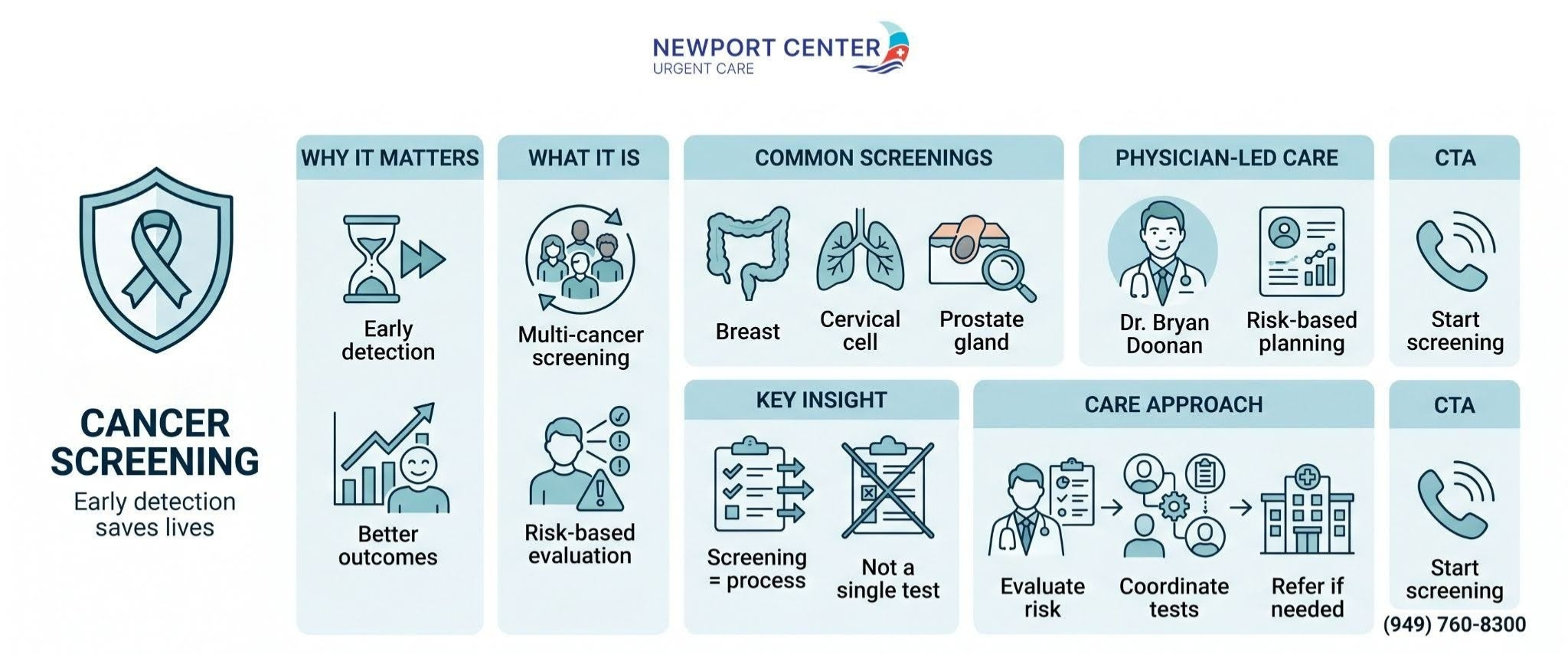
Cancer screening saves lives — not because it's a perfect science, but because it shifts the odds dramatically in your favor when something is found early. For most cancers, the difference between a stage one and a stage three diagnosis isn't luck — it's whether a screening happened. At Newport Center Urgent Care in Newport Beach, we provide comprehensive, physician-led cancer screening evaluations that cover multiple cancer types in a single visit, coordinating every test, referral, and follow-up under one roof.
Dr. Bryan Doonan and our team have been caring for patients in Newport Beach and Orange County for over 20 years. We understand that most adults know they should be screened — and most aren't, simply because the process feels fragmented, confusing, or inconvenient. We're here to change that. Whether you're coming in for a specific screening concern or want a broad preventive health evaluation, we'll build a screening plan around your individual risk profile and make sure it actually happens.
What "Comprehensive Cancer Screening" Actually Means
The term "cancer screening" covers a wide range of tests, clinical evaluations, and referral pathways — and most online listings treat it as though it were a single product you can simply order. In reality, appropriate cancer screening is a clinical process that begins with a thorough risk assessment. Age, sex, smoking history, family history, BMI, prior diagnoses, and lifestyle factors all affect which screenings are indicated, at what interval, and in what priority order.
At Newport Center Urgent Care, we don't hand you a checklist — we conduct a structured evaluation. Dr. Doonan reviews your complete health picture, identifies the screenings most relevant to your risk profile, and coordinates each one with the appropriate testing, imaging, or referral pathway. That's the difference between a comprehensive screening evaluation and a generic wellness visit.

The Cancer Screenings We Coordinate
Colorectal Cancer
Colorectal cancer is the second leading cause of cancer death in the United States and among the most preventable. We evaluate your risk profile, order stool-based testing when appropriate, and coordinate colonoscopy referrals to qualified gastroenterology practices throughout Orange County. The USPSTF recommends screening beginning at age 45 for average-risk adults — and earlier for those with elevated risk factors.
Lung Cancer
For high-risk patients with a significant smoking history, annual low-dose CT (LDCT) screening is the evidence-based standard for early lung cancer detection. We evaluate your eligibility using current USPSTF criteria, conduct a shared decision-making conversation before any referral is made, and coordinate imaging with accredited facilities throughout Orange County. Screening is only appropriate when a patient is also healthy enough to pursue follow-up testing and treatment if something is found — and that evaluation is always part of our process.
Skin Cancer
Orange County's year-round sun exposure makes skin cancer screening a particularly important part of preventive care for our patients. We perform full-body skin exams using the ABCDE criteria and evaluate for melanoma, basal cell carcinoma, squamous cell carcinoma, and precancerous actinic keratoses. The Skin Cancer Foundation recommends annual full-body exams for adults at elevated risk, and we provide that evaluation directly — no dermatology referral required to get started.
Breast Cancer
For women, breast cancer screening is one of the most important and time-sensitive preventive care items. We provide clinical breast exams as part of comprehensive health evaluations and coordinate mammography referrals to accredited imaging facilities throughout Orange County. The American Cancer Society recommends annual mammograms beginning at age 40 for women at average risk, with earlier screening for those with elevated genetic or familial risk.
Cervical Cancer
Cervical cancer screening through Pap smears and HPV co-testing remains one of the most effective cancer prevention tools in clinical medicine. We provide in-office cervical cancer screening for women as part of our primary care services, following current guidelines from the USPSTF for Pap smear frequency and HPV co-testing based on age and prior results.
Prostate Cancer
Prostate cancer screening through PSA testing is recommended for men in certain age groups following a shared decision-making discussion about benefits and limitations. We evaluate your individual risk — including age, family history, and race — and conduct that conversation with the clinical depth it deserves before any testing is ordered, consistent with USPSTF guidance on prostate cancer screening.
Screening Is a Process, Not a Single Test
Most people encounter cancer screening as a simple transaction: schedule a mammogram, complete a colonoscopy, or get a CT scan. But effective cancer screening is not a single event — it is a coordinated medical process that unfolds over time and requires multiple decision points working together.
The Four Stages of Effective Screening
That process begins with risk identification, where a clinician evaluates personal and family history, lifestyle factors, and age-related risk. It continues with eligibility determination, which aligns patients with evidence-based guidelines rather than self-selected testing. Only then does the screening test occur. What most online information leaves out is what happens next — and this is where outcomes are often decided.
Where Breakdowns Actually Happen
Research shows that breakdowns frequently occur after the initial screening step — particularly in completing timely follow-up after abnormal results — which can significantly delay diagnosis and care progression. The CDC and the USPSTF both emphasize that screening recommendations are not isolated tests but part of a broader preventive strategy that includes appropriate follow-up and clinical decision-making.
Completing the Full Chain of Care
The National Cancer Institute highlights that screening programs only reduce mortality when patients complete the full continuum — from detection through diagnostic resolution and treatment when needed. Most missed cancers do not occur because a screening test was never ordered, but because follow-up steps were delayed, fragmented, or never completed. Getting screened is not the end of prevention — it is the beginning of a pathway.
How We Manage That Pathway at Newport Center Urgent Care
At Newport Center Urgent Care, we don't issue a screening result and consider our job done. Dr. Doonan tracks your results, coordinates follow-up, and ensures that every step in the screening process — from evaluation through resolution — is connected and accounted for. That continuity is what turns a screening test into an outcome.
Screening Is Not Diagnosis — And That Distinction Matters
One of the most important things we explain to every patient is what a screening test can and cannot tell you. A screening test is designed to identify people who may have a condition before symptoms develop — it is not a definitive diagnosis. A positive or abnormal screening result means further evaluation is needed, not that cancer is confirmed. A negative result means no significant findings at this point in time, not a lifetime guarantee.
What Happens When a Finding Requires Follow-Up
When a screening result warrants further evaluation — whether that's a suspicious skin lesion, a positive stool test, a pulmonary nodule on CT, or an abnormal PSA level — the clinical pathway that follows is where outcomes are actually determined. At Newport Center Urgent Care, we don't issue a result and leave you to navigate the next step alone. Dr. Doonan explains what the finding means, what the evidence-based follow-up pathway looks like, and coordinates the appropriate specialist referral with full clinical documentation to support a smooth handoff.
When Reassurance Is the Right Outcome
Not every screening visit ends with a concerning finding — in fact, the majority don't. A normal result, properly contextualized by a physician who understands your risk profile, is genuinely reassuring in a way that a result forwarded to a patient portal without explanation is not. Part of what we provide at Newport Center Urgent Care is the clinical conversation that turns a number or image into something you actually understand and can act on.


Why Orange County Patients Choose Us for Preventive Care
We are not a screening kiosk or a hospital system with a six-week wait for a wellness appointment. We are a fully staffed, physician-led clinic that has served the Newport Beach community for over two decades — open seven days a week, accepting walk-ins, and offering same-day appointments for patients who want to prioritize their preventive health without rearranging their lives to do it.
What our patients experience at Newport Center Urgent Care is continuity. Dr. Doonan knows your history, tracks your results over time, and adjusts your screening plan as your risk profile evolves. We accept most major insurance plans, including Medicare — and under current preventive care guidelines, most recommended cancer screenings are covered at no cost-sharing for eligible patients. Getting screened shouldn't be difficult, and at our clinic, it isn't.
Get Your Cancer Screening Evaluation Today
We're open seven days a week, walk-ins are welcome, and same-day appointments are available. Our clinic is located at 360 San Miguel Drive, Suite 107, Newport Beach, CA 92660 — just across from Fashion Island, with easy parking and no referral required. Call us at (949) 760-8300 or visit newportbeachuc.com to schedule your evaluation.
Whether you're overdue for a specific screening, want a broad preventive health review, or have a family history you've been meaning to discuss with a physician, our team is ready to help. A comprehensive cancer screening evaluation at Newport Center Urgent Care is one of the most meaningful investments you can make in your long-term health.