TRT in Orange County | Testosterone Replacement Therapy

WHY CHOOSE TRT THERAPY in Newport Beach?
You’re eating well, staying active, and sleeping enough—yet your energy, drive, and body still feel off. Low testosterone may be the cause, and many men go undiagnosed. At Newport Center Urgent Care in Newport Beach, Dr. Bryan Doonan provides medically supervised TRT with same-day appointments, no referral, and over 20 years of trusted care.
Orange County offers many TRT clinics, but most rely on one-size-fits-all protocols with limited oversight. Newport Center Urgent Care is different—Dr. Bryan Doonan provides personalized, physician-led care with proper lab testing, tailored dosing, and ongoing monitoring throughout treatment.
What Is TRT and Who Is It For?
Testosterone replacement therapy (TRT) is a physician-prescribed treatment that restores levels in men with low testosterone (hypogonadism), confirmed through labs and symptoms. It’s a medically recognized treatment for a real hormonal deficiency affecting quality of life and long-term health. TRT is appropriate for adult men who have both confirmed low testosterone on lab work and symptoms consistent with deficiency.
The American Urological Association uses a total testosterone level below 300 ng/dL as the clinical threshold for low testosterone diagnosis, but candidacy for treatment depends on free testosterone, SHBG, symptom severity, and overall health history. At Newport Center Urgent Care, Dr. Doonan conducts a thorough evaluation before any treatment begins, ensuring that TRT is both medically indicated and the right fit for your individual profile.


Recognizing the Signs of Low Testosterone in Orange County Men
Low testosterone often develops gradually, with subtle changes mistaken for stress or aging. Common symptoms include persistent fatigue, muscle loss, increased body fat, low libido, erectile issues, mood changes, and brain fog. What makes Low T particularly easy to miss is that its symptoms overlap significantly with other conditions — depression, thyroid dysfunction, sleep apnea, and metabolic syndrome, among them.
This is why a proper lab evaluation is so important before any conclusions are drawn. At Newport Center Urgent Care, the diagnostic process starts with a comprehensive morning blood panel that includes total testosterone, free testosterone, SHBG, estradiol, LH, FSH, and metabolic markers — giving Dr. Doonan the full hormonal context needed to make an accurate diagnosis and a meaningful treatment recommendation.
TRT Treatment Options Available at Newport Center Urgent Care
There is no single delivery method that works best for every man, which is why Newport Center Urgent Care offers individualized TRT protocols rather than a one-size-fits-all approach. Common forms of testosterone therapy include intramuscular or subcutaneous injections, topical gels or creams, and transdermal patches.
Once treatment begins, regular monitoring is essential. Follow-up labs track testosterone, hematocrit, estradiol, PSA, and other markers to ensure safe, effective dosing. At Newport Center Urgent Care, your treatment is continuously adjusted to support long-term results.
Why Orange County Men Choose Newport Center Urgent Care for TRT
Newport Center Urgent Care is not a pop-up men's health franchise or a telehealth platform with no in-person oversight. It is a fully staffed, brick-and-mortar medical clinic located at 360 San Miguel Drive in Newport Beach — conveniently accessible for men throughout Orange County, including Irvine, Costa Mesa, Huntington Beach, Laguna Beach, Anaheim, and beyond. What truly sets Newport Center Urgent Care apart is continuity.
When you start TRT here, you’re consistently managed by Dr. Doonan and his team. The clinic is open seven days a week, accepts most insurance, including Medicare, and offers walk-ins and online booking, making expert care both accessible and reliable.
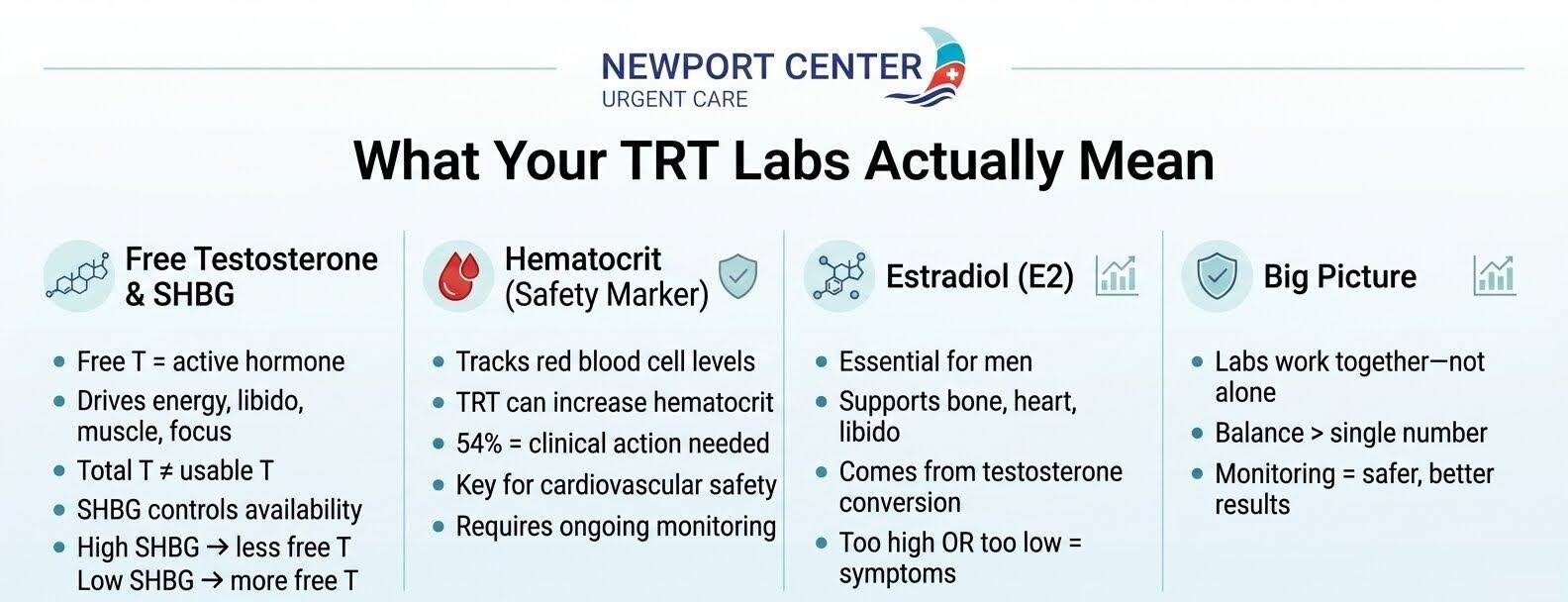
What Your TRT Labs Actually Mean
Free Testosterone and SHBG: The Numbers Behind the Number
While total testosterone gets the most attention, free testosterone is the biologically active fraction — the portion your body can actually use for energy, libido, muscle growth, and mental clarity. Total testosterone includes hormone bound to proteins, much of which is unavailable to tissues, which is why two men with the same total level can feel completely different.
The key regulator is sex hormone-binding globulin (SHBG), a protein that binds tightly to testosterone and controls how much remains free and usable. Higher SHBG significantly reduces active testosterone availability, while lower SHBG increases it — making SHBG a critical variable in accurately interpreting your results.
Hematocrit: The Safety Marker Every TRT Patient Needs to Monitor
From a safety standpoint, hematocrit is one of the most important markers to track while on TRT. Testosterone therapy is well established to increase red blood cell production by stimulating erythropoietin, which raises hematocrit levels across all delivery methods.
The AUA guideline specifies that a hematocrit of 54% or greater warrants clinical intervention — such as dose reduction or temporary discontinuation — as elevated levels increase blood viscosity and associated cardiovascular risk. This is why baseline hematocrit testing before starting TRT, and regular monitoring throughout, are non-negotiable components of responsible care at Newport Center Urgent Care.
Estradiol: A Critical Hormone for Men, Not Just Women
Estradiol (E2) is commonly misunderstood in the context of men's health. In men, estradiol is not a problematic hormone to be suppressed — it plays an essential role in bone density, cardiovascular protection, libido, and metabolic function. During TRT, a portion of testosterone is naturally converted into estradiol through a process called aromatization, and both excessively low and excessively high levels can produce symptoms.
Taken together, free testosterone, SHBG, hematocrit, and estradiol form an interconnected system — not a collection of isolated numbers — and proper TRT management means interpreting all of them together to keep your treatment both effective and physiologically balanced over time.


Start TRT in Orange County Today
If you're experiencing symptoms of low testosterone and want real answers backed by proper lab work and physician expertise, Newport Center Urgent Care is ready to help. Call (949) 760-8300 to speak directly with the care team, book an appointment online, or walk in at your convenience.
The clinic is located at 360 San Miguel Drive, Suite 107, Newport Beach, CA 92660 — just across from Fashion Island, with easy parking and no referral required. Whether you’re exploring TRT or already diagnosed, Dr. Doonan’s team provides personalized, accessible care built around your full health picture. Start with a consultation tailored to you—not a one-size-fits-all protocol.
Conclusion
Low testosterone is a treatable medical condition — and with the right physician-led care, it doesn't have to keep defining how you feel, perform, or live. Newport Center Urgent Care brings over 20 years of experience to TRT in Orange County, offering personalized, medically supervised care tailored to each patient—not a generic protocol.
Take the first step today. Call (949) 760-8300, visit newportbeachuc.com, or walk in to the clinic at your convenience. Same-day appointments are available, no referral is needed, and a treatment plan built around your actual health is closer than you think.