
Perimenopause Treatment in Newport Beach | Symptom Relief

WHY CHOOSE HORMONE REPLACEMENT THERAPY?
Hot flashes at 3 a.m., mood swings, and brain fog that disrupts your day may signal perimenopause—the transition before menopause that can start in your late 30s and last for years. Too often dismissed as “just aging,” these symptoms deserve real answers. At Newport Center Urgent Care in Newport Beach, Dr. Bryan Doonan provides medically supervised, personalized hormone care to help you feel like yourself again.
Newport Center Urgent Care has served the Orange County community for over 20 years, offering the kind of comprehensive, continuity-of-care experience that goes well beyond a standard urgent care visit.
What Is Perimenopause — and How Is It Different from Menopause?
Perimenopause is the hormonal transition before menopause, marked by fluctuating estrogen and progesterone. Unlike menopause—defined as 12 months without a period—it involves irregular cycles and a wide range of symptoms. It often begins in a woman’s 40s, can start earlier, and may last several years or longer.
Perimenopause can be difficult to identify because its symptoms often mimic thyroid issues, anxiety, fatigue, or depression. Without proper evaluation, they’re easily misattributed. At Newport Center Urgent Care, diagnosis begins with a thorough symptom review and targeted lab work to guide the right treatment plan.
Common Perimenopause Symptoms We Treat
Perimenopause affects nearly every system in the body, so symptoms vary widely. Common signs include irregular cycles, hot flashes, night sweats, sleep issues, vaginal dryness, low libido, weight gain—especially abdominal—joint aches, and urinary changes. Many women also experience brain fog and difficulty concentrating.
Emotional symptoms are just as common. Many women experience anxiety, irritability, low mood, or mood swings driven by hormonal changes affecting brain chemistry and sleep. At Newport Center Urgent Care, these symptoms are taken seriously and used to guide personalized treatment.

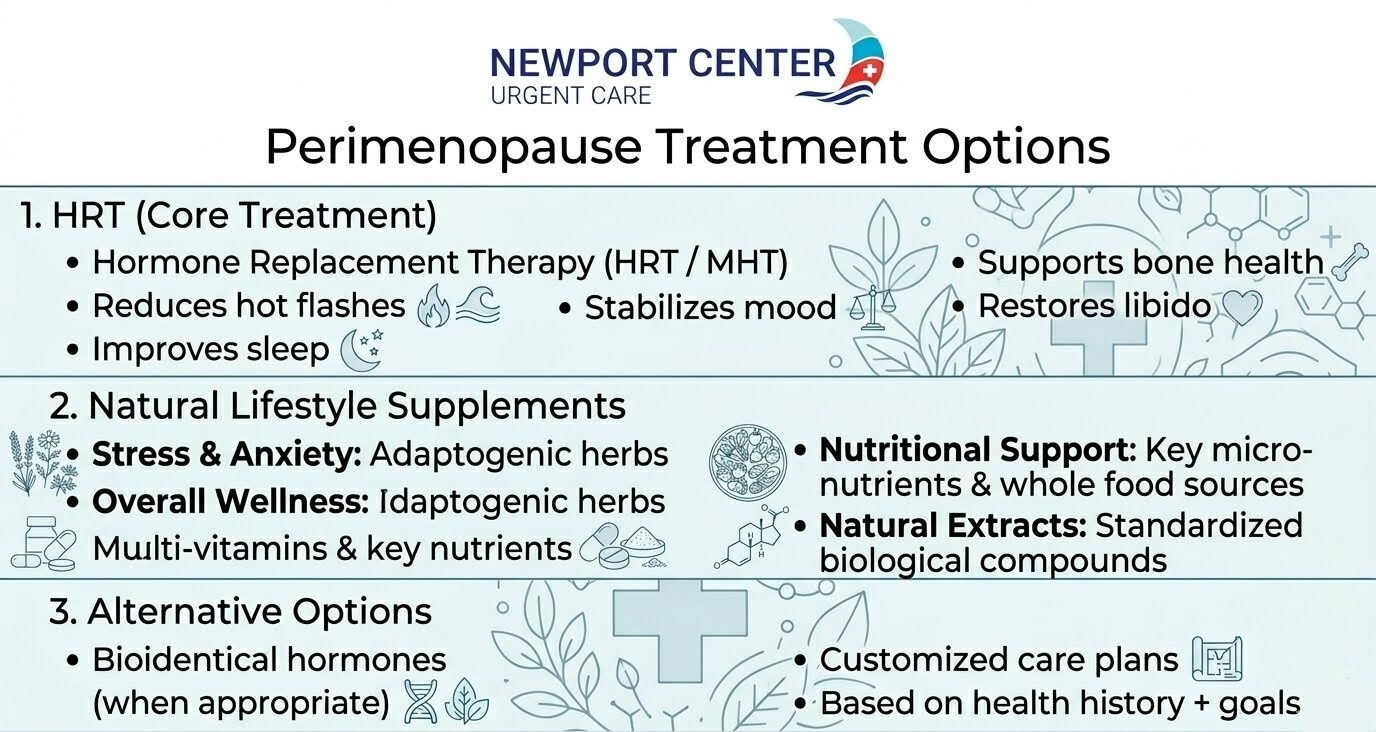

Perimenopause Treatment Options at Newport Center Urgent Care
The cornerstone of effective perimenopause symptom relief is hormone replacement therapy (HRT) — also referred to as menopausal hormone therapy (MHT). When appropriately prescribed and monitored, HRT can significantly reduce hot flashes, improve sleep quality, stabilize mood, protect bone density, and restore sexual comfort and libido.
At Newport Center Urgent Care, HRT is offered as part of a broader Hormone Replacement Therapy program that is fully supervised by Dr. Doonan, with ongoing lab monitoring to ensure your treatment remains safe and optimized over time.
Beyond HRT
HRT is not the only tool available. Depending on your symptoms, health history, and preferences, Dr. Doonan may also discuss non-hormonal options, lifestyle modifications, or complementary treatments.
For women who are not candidates for traditional HRT — due to certain medical histories — bioidentical hormone options and targeted interventions for individual symptoms may be explored. The goal is never to offer a one-size-fits-all protocol, but to build a care plan that reflects your unique biology, priorities, and long-term health goals.
Why Proper Diagnosis Matters Before Starting Treatment
One of the most common mistakes in perimenopause management is beginning treatment based on symptoms alone, without confirming the underlying hormonal picture through lab work.
Estrogen, progesterone, FSH (follicle-stimulating hormone), and thyroid function all interact in ways that can look similar on the surface but require very different interventions. For example, thyroid dysfunction — which is more common in women over 40 — can closely mimic perimenopausal symptoms, and treating the wrong condition can delay meaningful relief.
Evaluation Process at Newport Center Urgent Care
At Newport Center Urgent Care, the evaluation process is thorough and data-driven. Lab panels are reviewed in the context of your full symptom profile, medical history, and lifestyle factors — not interpreted in isolation.
This approach is what separates effective, targeted perimenopause care from the kind of generic advice that leaves women feeling unheard and undertreated. Once a complete picture is established, Dr. Doonan works with you to develop a treatment plan that evolves as your hormonal needs change over time.
Why Newport Center Urgent Care Is the Right Choice for Perimenopause Care in Newport Beach
Finding a trusted local provider for perimenopause care isn't always easy. Many women are referred to specialists with long wait times, or they turn to telehealth-only services that can't offer the hands-on clinical oversight that hormone therapy requires. Newport Center Urgent Care bridges that gap — offering the accessibility and speed of an urgent care model with the depth and clinical continuity of a primary care practice led by an experienced physician.
Dr. Bryan Doonan and his team have served the Newport Beach and Orange County community for over 20 years. The clinic is open seven days a week with walk-ins welcome, offering accessible, compassionate hormone care without referral delays.
What Your Perimenopause Lab Results Actually Mean
FSH: A Rising Signal, Not a Definitive Answer
One of the most commonly measured markers in perimenopause is follicle-stimulating hormone (FSH), which rises as the ovaries produce less estrogen. FSH levels in the 10–30 mIU/mL range may suggest perimenopause, especially when symptoms are present, while levels consistently above 30 mIU/mL are generally associated with menopause.
However, FSH is not a stable or reliable standalone marker during this phase — levels can fluctuate significantly from cycle to cycle and may not stabilize until well after menopause is reached. A single elevated FSH result does not confirm perimenopause, and a normal result does not rule it out.
Estradiol: The Hormone That Doesn't Decline Smoothly
Estradiol (E2), the primary form of estrogen, behaves even more unpredictably during perimenopause. Rather than steadily declining, estradiol levels can rise, fall, and spike erratically — sometimes averaging 20–30% higher than premenopausal levels before eventually dropping in the later stages of the transition.
This variability is precisely why a single estradiol measurement often fails to reflect your true hormonal picture. Your labs may appear entirely "normal" on paper while you're experiencing significant symptoms like hot flashes, anxiety, or sleep disruption — and that disconnect is clinically meaningful, not imaginary.
Thyroid and the Full Picture: Why Labs Support — Not Replace — Clinical Judgment
Because of the inherent variability in perimenopause hormones, clinical guidelines emphasize that diagnosis is largely based on symptoms, menstrual pattern changes, and overall clinical context — with labs used to support, not replace, that judgment. Thyroid-stimulating hormone (TSH) is often included in the evaluation panel because thyroid dysfunction — particularly in women over 40 — can closely mimic perimenopausal symptoms, including fatigue, mood changes, heat sensitivity, and irregular cycles.
At Newport Center Urgent Care, Dr. Doonan interprets your complete panel in the context of how you actually feel — because in perimenopause, your symptoms are always part of the diagnosis.


Start Your Perimenopause Treatment Today
If you're ready to stop guessing and start getting real relief, Newport Center Urgent Care makes it easy. Call (949) 760-8300 to speak directly with the care team, book an appointment online, or simply walk in at your convenience. The clinic is located at 360 San Miguel Drive, Suite 107, Newport Beach, CA 92660 — just across from Fashion Island with easy parking.
Newport Center Urgent Care accepts a wide range of insurance plans and is happy to help you verify coverage before your visit. Whether you're just beginning to notice perimenopausal symptoms or you've been struggling for years without effective treatment, a consultation with Dr. Doonan is the first step toward feeling balanced, energized, and in control again.
Conclusion
Perimenopause isn’t something you have to endure. With the right care, symptoms affecting your sleep, mood, and daily life can be significantly improved. Newport Center Urgent Care, led by Dr. Bryan Doonan, provides personalized treatment in a trusted Newport Beach clinic.
Don't wait for symptoms to get worse before seeking help. Call (949) 760-8300, visit newportbeachuc.com, or stop by the clinic today. Same-day appointments are available, walk-ins are always welcome, and real relief is closer than you think.