
Prostate Cancer Screening Near Me: PSA Testing Orange County

WHY CHOOSE PSA TESTING in Newport Beach?
Prostate cancer is the most commonly diagnosed cancer in American men — and when detected early, it is among the most treatable. The challenge is that early-stage prostate cancer rarely causes symptoms, which means most men who are diagnosed either did so through routine screening or not at all until the disease had progressed. At Newport Center Urgent Care in Newport Beach, we provide PSA testing and prostate cancer screening evaluations as part of our comprehensive preventive care services — with same-day appointments, no referral required, and physician-led interpretation of every result.
Dr. Bryan Doonan and our team understand that prostate cancer screening is one of the most clinically nuanced conversations in men's health. PSA testing carries both significant benefits and well-documented limitations, and the decision to screen — and how to act on a result — requires a physician who can interpret your individual risk, not just run a number through a reference range. That conversation is exactly what we provide at Newport Center Urgent Care.
What PSA Testing Is — and What It Isn't
PSA, or prostate-specific antigen, is a protein produced by both normal and abnormal prostate tissue. A PSA blood test measures the concentration of this protein in the bloodstream. Elevated PSA levels can indicate prostate cancer, but they can also result from benign prostatic hyperplasia (BPH), prostatitis, recent ejaculation, or vigorous physical activity. This is a critical distinction — PSA is a risk signal, not a cancer diagnosis.
A PSA test result must be interpreted in clinical context. A value above the commonly cited threshold of 4.0 ng/mL is not automatically cause for alarm, and a value below it is not a guarantee that cancer is absent. What matters is the trend over time, the rate of change (PSA velocity), the ratio of free to total PSA, and your individual risk factors. At Newport Center Urgent Care, Dr. Doonan interprets your PSA result within that full clinical picture — not as an isolated number.

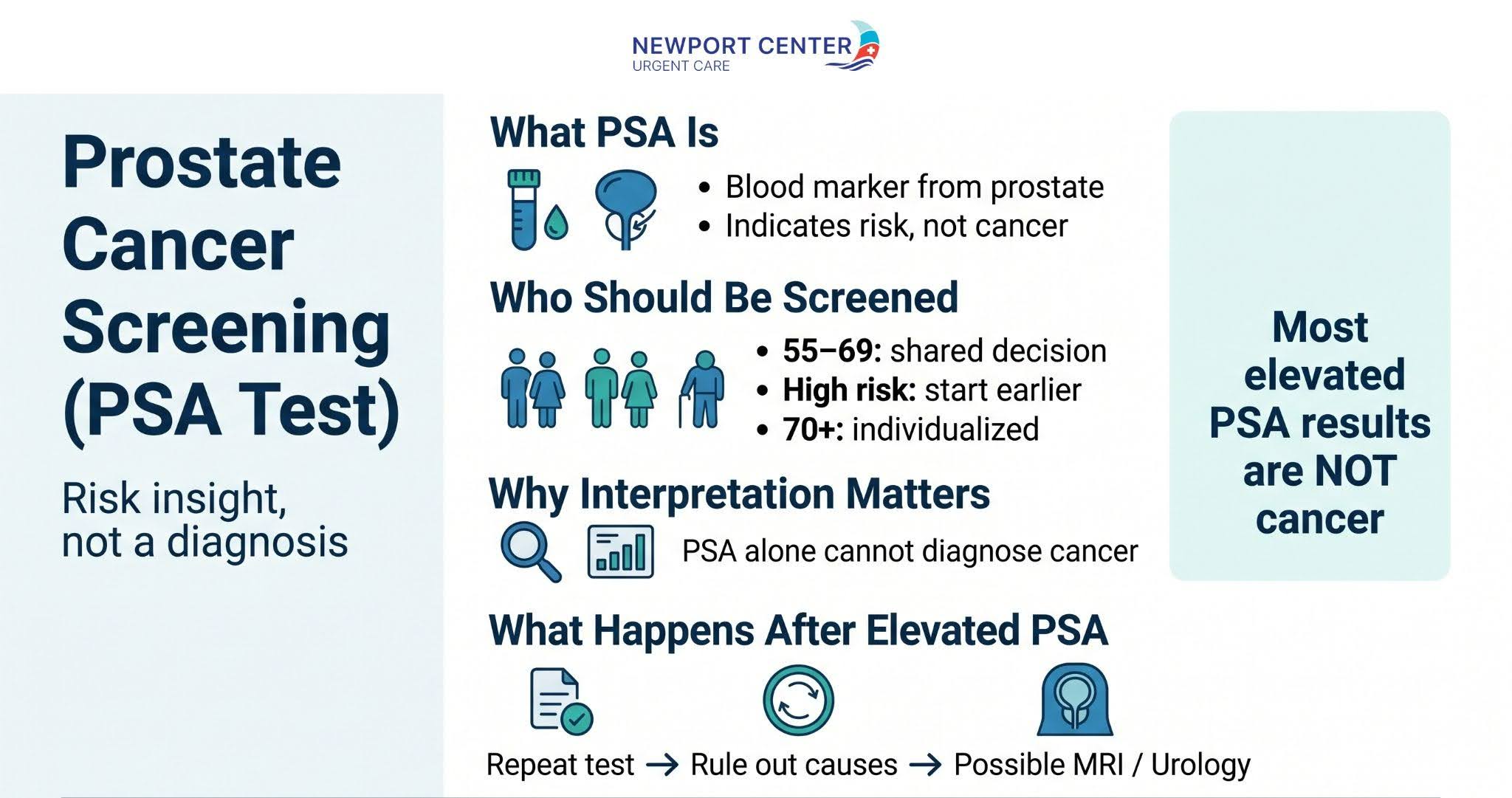

Who Should Be Screened and When
Average-Risk Men
The USPSTF recommends that men aged 55 to 69 discuss the potential benefits and harms of PSA screening with their physician before deciding whether to be tested. This shared decision-making requirement reflects the fact that PSA screening carries real benefits — primarily the detection of potentially lethal cancers at a treatable stage — alongside real risks, including overdiagnosis and overtreatment of cancers that may never have caused harm.
Elevated-Risk Men
Men at elevated risk should consider earlier screening discussions, typically beginning at age 40 to 45. Elevated risk includes African American men, who have a significantly higher incidence of prostate cancer and tend to be diagnosed at younger ages, and men with a first-degree relative diagnosed with prostate cancer before age 65. The American Cancer Society recommends that high-risk men have this discussion earlier than the average-risk population.
Men Over 70
For men aged 70 and older, the USPSTF recommends against routine PSA screening, as the potential harms of overdiagnosis and unnecessary treatment typically outweigh the benefits in this age group. However, this is not an absolute rule — men in excellent health with a long life expectancy may still benefit from a physician-led discussion about continued screening. Dr. Doonan evaluates each patient individually rather than applying age cutoffs without clinical context.
PSA Is Not a Result — It Is the Start of a Diagnostic Pathway
A PSA test is often presented online as a simple binary outcome — either "normal" or "elevated." In clinical practice, a PSA value is not a diagnosis and not a clinical endpoint. It is the beginning of a decision-making cascade that may or may not ultimately lead to a cancer diagnosis.
A Risk-Stratification Tool, Not a Definitive Test
Current guidelines emphasize that PSA screening should be understood as a risk-stratification tool. The USPSTF explicitly recommends shared decision-making because the downstream consequences of PSA testing vary significantly depending on how results are interpreted and managed. The test itself is simple — the clinical pathway it triggers is not.
The Staged Evaluation That Follows
When a PSA result is elevated, the next steps are rarely immediate treatment. Clinicians typically move through a structured sequence: repeat PSA testing to confirm persistence, assessment of benign causes such as prostatitis or recent physical activity, and reflex testing such as free-to-total PSA ratios or other biomarkers. In selected cases, patients may then be referred for multiparametric MRI to better characterize prostate tissue before any biopsy is considered.
Where the Real Risk Lies
Evidence from the National Cancer Institute highlights that many PSA-detected abnormalities do not represent clinically significant disease — and that harms from screening often arise from downstream interventions rather than the blood test itself. The American Urological Association similarly frames PSA testing as the entry point into a broader diagnostic process rather than a standalone screening outcome.
What This Means at Newport Center Urgent Care
Only after stepwise evaluation does the pathway diverge into surveillance, biopsy, or treatment decisions — each carrying distinct risks and benefits. At Newport Center Urgent Care, Dr. Doonan manages that entire pathway with you, from the initial PSA value through every decision point that follows — so you're never left interpreting a number without clinical guidance behind it.
Interpreting Your PSA Result: What the Numbers Mean
Understanding the Reference Range
The commonly cited normal PSA threshold of 4.0 ng/mL is a population-based reference range, not a clinical bright line. Many prostate cancers occur in men with PSA levels below 4.0, and many elevated PSA values are caused by benign conditions. Age-adjusted PSA ranges are increasingly used because PSA naturally rises with age as the prostate grows, and a PSA of 3.5 ng/mL may be more significant in a 45-year-old than in a 70-year-old.
PSA Velocity and Trend
PSA velocity — the rate of change in PSA over time — is often more clinically meaningful than any single measurement. A PSA that rises from 1.5 to 3.5 ng/mL over 12 months is more concerning than a stable PSA of 4.2 ng/mL across multiple years. This is why baseline testing and serial monitoring matter, and why Dr. Doonan tracks your results over time rather than evaluating each one in isolation.
Free PSA Ratio
The ratio of free PSA to total PSA provides additional diagnostic information when total PSA is elevated. A lower free PSA ratio is associated with a higher likelihood of prostate cancer, while a higher ratio suggests benign prostatic disease. At Newport Center Urgent Care, we use these nuanced markers — not just the headline number — to guide clinical decision-making and determine whether further evaluation is warranted.
What Happens After an Abnormal PSA Result
Repeat Testing and Confirmation
An elevated PSA on a single test does not automatically require biopsy. Many physicians recommend repeat PSA testing after four to six weeks — avoiding factors that can transiently elevate PSA, such as recent ejaculation, prostatitis, or vigorous cycling — before escalating the workup. A persistent elevation on repeat testing is more clinically significant than a single abnormal value.
Specialist Referral and Further Evaluation
If PSA elevation persists after repeat testing and clinical context supports further evaluation, we coordinate referral to a urologist for specialist assessment. This may include multiparametric MRI of the prostate before biopsy — an approach increasingly supported by the American Urological Association to improve biopsy targeting and reduce unnecessary procedures. At Newport Center Urgent Care, we provide the complete clinical documentation needed to make that handoff as efficient and well-informed as possible.
What a Normal Result Means
A normal PSA result provides meaningful reassurance — but it is not a permanent guarantee. PSA levels should be monitored at intervals determined by your baseline level and risk profile. The National Cancer Institute notes that ongoing surveillance is a core part of responsible prostate cancer prevention, not a one-time test. Dr. Doonan will establish the right monitoring schedule for your individual profile and ensure your results are tracked consistently over time.


Why Orange County Men Choose Us for PSA Testing
At Newport Center Urgent Care, PSA testing is not a standalone order — it is embedded in a clinical evaluation that includes your complete health history, risk factor assessment, and a direct conversation about what the result will and won't tell us. We are a fully staffed, physician-led clinic located at 360 San Miguel Drive, just across from Fashion Island, serving patients throughout Orange County including Irvine, Costa Mesa, Laguna Beach, Huntington Beach, and Anaheim.
We're open seven days a week, walk-ins are always welcome, and same-day appointments are available. We accept most major insurance plans, including Medicare. Call us at (949) 760-8300, book online at newportbeachuc.com, or walk in at your convenience — no referral required.