
Newport Beach Retatrutide Clinical Trials: Advanced Weight Loss Research

WHY CHOOSE RETATRUTIDE IN NEWPORT BEACH?
Retatrutide has become one of the most searched terms in weight-loss medicine, and for good reason — the clinical trial results behind it are unlike anything seen before in an investigational drug. For Orange County residents trying to understand what this research actually means for them, Newport Center Urgent Care in Newport Beach offers a place to start: physician-supervised, compounded retatrutide guided directly by Dr. Bryan Doonan's review of the latest trial data.
It's worth clarifying upfront what this means in practice. Newport Center Urgent Care is not an enrolling site for Eli Lilly's clinical trials, and patients here are not trial participants. Instead, Dr. Doonan uses the published results from those trials to inform a compounded, off-label treatment protocol — giving patients access to a physician-guided option built on real research, not guesswork.
How Phase 3 Clinical Trials Work — and Why They Matter
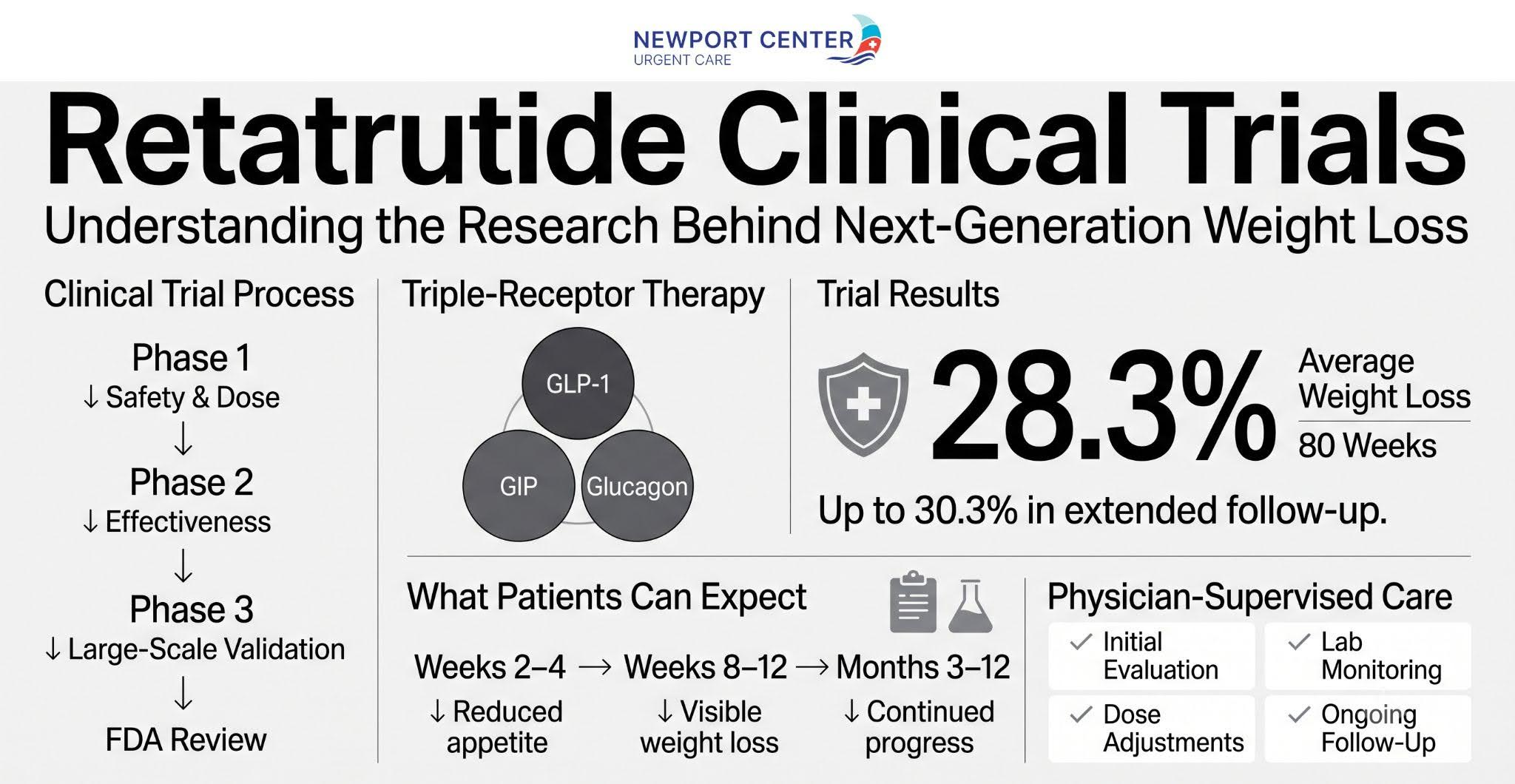
When you read that retatrutide is in Phase 3 clinical trials, it's worth understanding why that milestone carries so much weight. Every new medication follows a structured research pathway designed to answer different questions about safety and effectiveness before it can be reviewed for FDA approval.
Clinical Trial Phase | Primary Purpose |
Phase 1 | Evaluates initial safety, dosing, and how the drug behaves in the body using a small group of participants. |
Phase 2 | Tests whether the medication works as intended while continuing to monitor side effects and determine the most appropriate dose. |
Phase 3 | Enrolls hundreds to thousands of participants to confirm effectiveness, compare outcomes, and collect the extensive safety data needed for regulatory review. |
FDA Review | The FDA independently evaluates all available evidence before deciding whether the medication should be approved for public use. |
Phase 3 trials are considered far more reliable than earlier studies because they involve much larger and more diverse patient populations over longer periods of time, allowing researchers to understand not only how well a medication works but also how consistently it performs across different groups. The FDA considers this comprehensive evidence — not just positive weight-loss results — reviewing clinical trial data, manufacturing quality, labeling, and overall safety through its New Drug Application process before making an approval decision. Even highly successful Phase 3 results, like those retatrutide has produced so far, do not automatically mean a drug is FDA-approved. Once a medication is approved, the FDA still requires ongoing post-marketing surveillance, known as Phase 4, to monitor long-term safety and rare adverse events in broader, real-world populations.


What the Retatrutide Clinical Trials Actually Show
Retatrutide's research program is built around Eli Lilly's TRIUMPH trial series, a set of large Phase 3 studies examining the drug across obesity, diabetes, sleep apnea, and related conditions. The flagship TRIUMPH-1 trial enrolled thousands of participants with obesity or a BMI of 27 or higher with weight-related health issues, tracking outcomes over roughly two years. Results from that trial, also detailed in a published Phase 3 clinical trial report, showed average weight loss of 28.3% at 80 weeks on the highest dose, with some participants reaching 30.3% by 104 weeks.
A separate diabetes-focused trial, TRANSCEND-T2D-1, studied retatrutide's effect on blood sugar control alongside weight loss in participants with type 2 diabetes, confirming a 2.0% reduction in HbA1c together with 16.8% weight loss. Taken together, these trials represent one of the most extensive investigational datasets ever compiled for a metabolic medication, and they're the foundation Dr. Doonan draws on when building treatment plans at Newport Center Urgent Care.
Retatrutide vs. Bariatric Surgery: Why Researchers Compare Them
One of the biggest reasons retatrutide has generated so much attention is that the amount of weight loss reported in these trials approaches what has traditionally only been achieved through bariatric surgery. Those TRIUMPH-1 results — 28.3% average weight loss at 80 weeks, with a subset reaching 30.3% at 104 weeks — fall within the range commonly reported after sleeve gastrectomy. That makes retatrutide one of the first investigational medications to demonstrate surgical-level weight loss in a large clinical trial population.
Factor | Retatrutide | Gastric Sleeve |
Average weight loss | ~28–30% (Phase 3 trials) | 25–35% |
Surgery required | No | Yes |
Recovery | None | Typically 2–6 weeks |
Permanent anatomy changes | No | Yes |
Reversible | Yes, treatment can be discontinued | No |
Risk of nutritional deficiencies | Lower | Higher due to reduced stomach capacity |
Despite these similarities, medication and surgery are not interchangeable treatments. Bariatric surgery has decades of long-term outcome data showing durable weight loss and improvements in obesity-related conditions, while retatrutide remains investigational and continues to be evaluated for long-term safety and effectiveness. Surgery may still be the preferred option for patients with severe obesity or those needing rapid, sustained weight reduction, while patients who wish to avoid an operation may benefit from physician-supervised medication management. The most appropriate treatment depends on an individual's health history and a conversation with an experienced provider like Dr. Doonan.
From Trial Data to Real-World Treatment: How Newport Center Urgent Care Applies the Research
Reading a clinical trial abstract is very different from translating those findings into a safe, individualized treatment plan, and that gap is where Dr. Doonan's role matters most. Because retatrutide has not yet received FDA approval as a finished pharmaceutical product, it isn't available through a standard pharmacy prescription. At Newport Center Urgent Care, it's offered instead as a compounded peptide, prepared from pharmaceutical-grade active ingredient and administered under direct physician supervision — the same off-label model long used for other compounded hormone and peptide therapies.
This distinction matters for patients weighing their options. Compounded, physician-directed treatment means dosing decisions, lab monitoring, and safety oversight are handled by a real clinician who has reviewed the trial safety data — not a subscription service that ships medication with minimal follow-up. Every patient undergoes an individual evaluation before starting, and treatment is adjusted based on labs and response rather than following a fixed, generic protocol.
What the Safety Data Says
Clinical trial data isn't just about how much weight participants lost — it's also about what happens along the way, and that safety picture is central to how treatment is managed at Newport Center Urgent Care. Across the TRIUMPH trials, discontinuation rates due to side effects ranged from roughly 4% to 11% depending on dose, compared to about 5% on placebo. Dysesthesia, an altered or abnormal sensation, was reported in up to 12.5% of patients on the highest dose, while gastrointestinal symptoms like nausea and constipation were the most commonly reported issues overall.
None of this is unusual for a medication in this drug class, but it underscores why ongoing monitoring is non-negotiable. Dr. Doonan reviews these same safety signals when deciding on starting doses, titration schedules, and how closely a given patient needs to be followed. Patients with a history of pancreatitis, thyroid cancer, or significant gastrointestinal disease are screened for during the initial evaluation specifically because the trial data flagged these as areas requiring caution.
Retatrutide Timeline: What to Expect Week by Week
Every patient responds differently, but there's a general pattern seen across trial participants and real-world compounded protocols alike. In the first two to four weeks, most patients notice reduced appetite and early shifts in eating habits as the medication builds up in the system, with nausea or mild GI discomfort being common initially and typically improving as the body adjusts.
By weeks eight to twelve, measurable weight loss usually becomes noticeable, along with improved energy and more stable blood sugar for many patients. The most significant changes tend to build gradually between months three and twelve, mirroring the trajectory seen in the TRIUMPH trials, where results continued to improve well past the one-year mark. Dr. Doonan adjusts dosing along the way based on labs, tolerability, and progress, rather than following a fixed, one-size-fits-all schedule.


Is Retatrutide Right for You? What the Evaluation Involves
Not everyone is a candidate for retatrutide, which is why the process at Newport Center Urgent Care starts with a comprehensive evaluation rather than a walk-up injection. This includes a review of weight history, metabolic labs (including HbA1c, lipid panel, and thyroid function), current medications, and any history of pancreatitis, thyroid cancer, or gastrointestinal disease. Dr. Doonan uses this information to determine whether retatrutide, another GLP-1 option, or a different approach entirely is the safest and most effective path for a given patient.
Ongoing monitoring continues after treatment starts, with follow-up labs and check-ins to track progress and catch any issues early. This isn't a "prescribe and forget" model — it's continuous, physician-led care, which is a meaningful difference from telehealth subscriptions that ship medication with minimal oversight and little opportunity to ask questions along the way.
Why Orange County Patients Choose Newport Center Urgent Care
Newport Center Urgent Care isn't a pop-up weight-loss franchise or an online-only provider. It's a full, brick-and-mortar medical clinic at 360 San Miguel Drive in Newport Beach, directly across from Fashion Island, serving patients throughout Orange County — including Irvine, Costa Mesa, Huntington Beach, Laguna Beach, and Anaheim. The clinic is open seven days a week, accepts walk-ins, and offers same-day appointments with no referral required.
What sets the experience apart is continuity of care. When a patient starts a retatrutide protocol here, they're managed consistently by Dr. Doonan and his team from the first lab draw through every dose adjustment, rather than being passed between different providers at each visit. Call (949) 760-8300, book online, or simply walk in to start with a consultation.