
Retatrutide Weight Loss Orange County: Timelines & Expected Results

WHY CHOOSE RETATRUTIDE IN NEWPORT BEACH?
You've tried the diets, tracked the macros, and put in the gym hours — yet the number on the scale barely moves. For many Orange County patients, the missing piece isn't willpower; it's biology. At Newport Center Urgent Care in Newport Beach, Dr. Bryan Doonan offers physician-supervised, compounded retatrutide for qualified patients, backed by over 20 years of clinical experience and same-day appointments.
Retatrutide is one of the most talked-about weight-loss peptides in metabolic medicine, and for good reason: Phase 3 trial data has shown weight loss results consistent with bariatric surgery outcomes. Unlike medical spas or online telehealth platforms with limited oversight, Newport Center Urgent Care provides retatrutide as a compounded, physician-directed treatment — with proper lab work, dosing supervision, and ongoing monitoring built into every plan.
What Is Retatrutide, and Where Does It Stand Today?
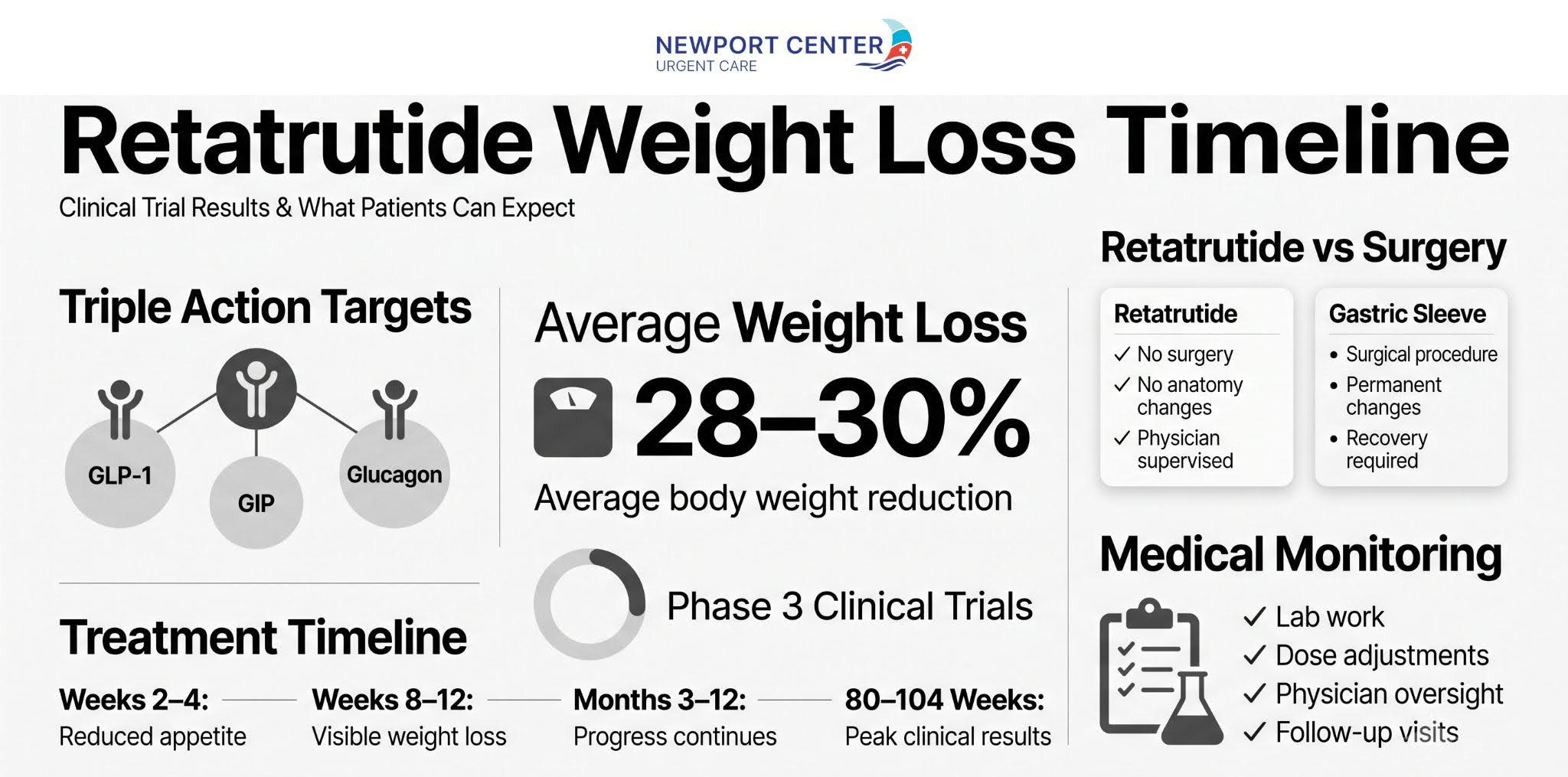
Retatrutide is a triple agonist that targets three separate metabolic receptors — GIP, GLP-1, and glucagon — rather than the single or dual pathways used by earlier weight-loss medications. This broader mechanism is part of why researchers believe it may produce more significant results than semaglutide or tirzepatide alone. It was developed by Eli Lilly under the investigational name LY3437943 and has moved through Phase 2 and into large-scale Phase 3 testing, with multiple trials now reporting data across obesity, diabetes, and related conditions.
It's important for patients to understand where the drug currently stands: retatrutide has not yet received FDA approval as a finished pharmaceutical product, and it remains under active investigation in Eli Lilly's Phase 3 TRIUMPH trial program. At Newport Center Urgent Care, retatrutide is offered as a compounded peptide, prepared from pharmaceutical-grade active ingredient and administered under Dr. Doonan's direct medical supervision — the same off-label, physician-directed model long used for other compounded hormone and peptide therapies. Every patient is evaluated individually before treatment begins, and no one is placed on a protocol without a documented medical reason to pursue it.


Retatrutide vs. Bariatric Surgery: Why Researchers Compare Them
One of the biggest reasons retatrutide has generated so much attention is that the amount of weight loss reported in clinical trials approaches what has traditionally only been achieved through bariatric surgery. In Eli Lilly's Phase 3 TRIUMPH-1 trial, participants receiving the highest dose of retatrutide lost an average of 28.3% of their body weight after 80 weeks, with a subset reaching 30.3% after 104 weeks. Those results fall within the range commonly reported after sleeve gastrectomy, making retatrutide one of the first investigational medications to demonstrate surgical-level weight loss in a large clinical trial.
Factor | Retatrutide | Gastric Sleeve |
Average weight loss | ~28–30% (Phase 3 trials) | 25–35% |
Surgery required | No | Yes |
Recovery | None | Typically 2–6 weeks |
Permanent anatomy changes | No | Yes |
Reversible | Yes, treatment can be discontinued | No |
Risk of nutritional deficiencies | Lower | Higher due to reduced stomach capacity |
Despite these similarities, medication and surgery are not interchangeable treatments. Bariatric surgery has decades of long-term outcome data showing durable weight loss and improvements in obesity-related conditions, while retatrutide remains investigational and continues to be evaluated for long-term safety and effectiveness.
Surgery may still be the preferred option for patients with severe obesity, those needing rapid and sustained weight reduction, or individuals who have not achieved adequate results with medical therapy. Conversely, patients who wish to avoid an operation or who are not good surgical candidates may benefit from physician-supervised medication management, and the most appropriate treatment depends on an individual's health history, weight-loss goals, and a conversation with an experienced provider like Dr. Doonan.
What the Clinical Data Shows So Far
Beyond the surgery comparison, retatrutide's broader dataset is substantial and worth understanding before you start. A separate trial in patients with type 2 diabetes, TRANSCEND-T2D-1, confirmed a 2.0% reduction in HbA1c along with 16.8% weight loss in 537 participants, suggesting benefits that extend beyond weight alone. A related sleep apnea substudy nested within the TRIUMPH-1 population has also pointed toward meaningful improvements in breathing-related sleep disruption, an area where weight loss has long been known to help.
These aren't small, short-term studies — they're large, multi-year trials designed to support future regulatory submissions, and the safety data collected alongside the weight-loss results matters just as much as the numbers on the scale. Discontinuation rates due to side effects ranged from roughly 4% to 11% depending on dose, compared to about 5% on placebo, with dysesthesia reported in up to 12.5% of patients on the highest dose. This is exactly why physician oversight — not a one-size-fits-all injection protocol — matters throughout treatment, and why Dr. Doonan reviews trial safety data as closely as he reviews the efficacy results.
Retatrutide Timeline: What to Expect Week by Week
Every patient responds differently, but there's a general pattern seen across clinical trial participants and real-world compounded protocols. In the first two to four weeks, most patients notice reduced appetite and early shifts in eating habits as the medication builds up in the system. Nausea or mild GI discomfort is common initially and typically improves as the body adjusts to dosing, and starting at a lower dose before titrating upward is one of the main ways this is managed.
By weeks eight to twelve, measurable weight loss usually becomes noticeable, along with improved energy and more stable blood sugar for many patients. The most significant changes tend to build gradually between months three and twelve, mirroring the trajectory seen in the TRIUMPH trials, where results continued to improve well past the one-year mark. Dr. Doonan adjusts dosing along the way based on labs, tolerability, and progress — not a fixed, generic schedule — and patients are seen regularly enough that small issues get caught before they become setbacks.
Supporting Long-Term Success Alongside Treatment
Retatrutide can meaningfully reduce appetite and support significant weight loss, but medication alone rarely produces the best or most lasting outcome. Patients who pair treatment with adequate protein intake, resistance training, and consistent sleep tend to preserve more lean muscle mass while losing fat, which matters both for how results look and how the body functions afterward. Dr. Doonan discusses these lifestyle factors as part of the initial consultation, rather than treating the injection as a standalone fix.
This is also where ongoing lab monitoring pays off in practical terms. Tracking markers like lean mass, metabolic panel results, and nutrient levels over time helps identify if a patient needs additional support, such as dietary adjustments or supplementation, well before it becomes a bigger problem. The goal at Newport Center Urgent Care isn't just short-term weight loss — it's a plan that a patient can sustain and feel good in for the long run.


Is Retatrutide Right for You? What the Evaluation Involves
Not everyone is a candidate for retatrutide, which is why the process at Newport Center Urgent Care starts with a comprehensive evaluation rather than a walk-up injection. This includes a review of your weight history, metabolic labs (including HbA1c, lipid panel, and thyroid function), current medications, and any history of pancreatitis, thyroid cancer, or gastrointestinal disease. Dr. Doonan uses this information to determine whether retatrutide, another GLP-1 option, or a different approach entirely is the safest and most effective path for you.
Ongoing monitoring continues after treatment starts, with follow-up labs and check-ins to track progress and catch any issues early. This isn't a "prescribe and forget" model — it's continuous, physician-led care, which is a meaningful difference from telehealth subscriptions that ship medication with minimal oversight and little opportunity to ask questions along the way.
Why Orange County Patients Choose Newport Center Urgent Care
Newport Center Urgent Care isn't a pop-up weight-loss franchise or an online-only provider. It's a full, brick-and-mortar medical clinic at 360 San Miguel Drive in Newport Beach, directly across from Fashion Island, serving patients throughout Orange County — including Irvine, Costa Mesa, Huntington Beach, Laguna Beach, and Anaheim. The clinic is open seven days a week, accepts walk-ins, and offers same-day appointments with no referral required.
What sets the experience apart is continuity of care. When you start a retatrutide protocol here, you're managed consistently by Dr. Doonan and his team from your first lab draw through every dose adjustment, rather than being passed between different providers at each visit. Call (949) 760-8300, book online, or simply walk in to start with a consultation.